Best Hairstyles to Look 10 Years Younger
Hair doesn't age on a predictable schedule, but the visual signals that read as "older" are more specific than most people assume — hair that's grown heavy at the ends, lost its shine, or sits at one flat length past the jaw. None of that is permanent. A different cut, a softer parting, or a change in how light bounces off the surface can shift it within a single salon visit.
This guide breaks down what dermatology and cosmetic-science research actually says makes hair read as younger — think of "10 years younger" as shorthand for that effect, not a literal guarantee — then translates the science into specific cuts, not generic "ask for layers" advice. Want to see one on yourself first? FaceStyle.fun's Layered preset previews it in seconds.
Key Takeaways
- In a 2025 rating study (International Journal of Cosmetic Science), hair with high shine and straight, aligned strands was judged more youthful, healthier, and more attractive than styles without those traits — alignment mattered more than shine alone (Will et al., 2025).
- Face-framing layers and curtain bangs "completely soften and frame the entire face for a softer, more youthful look," according to celebrity stylist Michelle Cleveland (Glam, 2024).
- Hair density peaks around age 27 and declines from the mid-30s onward (Ahluwalia & Fabi, Journal of Cosmetic Dermatology, 2019) — which is why volume-adding layering matters more with age, not less.
- The popular "50% gray by age 50" rule is an overestimate: a British Journal of Dermatology study found only 6-23% of people actually reach 50% gray coverage by 50, depending on ethnicity (Panhard, Lozano & Loussouarn, 2012).
Why Hair Starts to "Read" Older in the First Place
Two separate things happen to hair with age, and they call for different fixes. The first is structural: density peaks around age 27 and begins declining from the mid-30s onward, according to a 2019 study in the Journal of Cosmetic Dermatology. The second is pigment-related — melanocyte activity slows and gray strands increase, though not nearly as fast as popular wisdom claims (more on that below).
Female pattern hair loss (FPHL) compounds the density issue for a meaningful share of women. A 2021 study in the Journal of the American Academy of Dermatology tracked prevalence rising sharply with age.
The American Academy of Dermatology puts total androgenetic hair loss at roughly 80 million Americans — 50 million men and 30 million women.
| Age group | Female pattern hair loss prevalence |
|---|---|
| 20-29 | 8% |
| 50-65 (postmenopausal) | 52.2% |
| 60-75 | 68% |
This isn't about vanity — it's why a cut that relied on natural thickness at 25 can look flat at 45 without a styling adjustment. The hair changed; the fix is a different cut, not a judgment about your hair.
What Actually Makes Hair Look More Youthful
A 2025 study in the International Journal of Cosmetic Science put this to the test directly. Researchers had roughly 1,500 to 2,000 female raters across the US, Germany, and Spain judge photos with systematically manipulated hair — some shinier, some straighter, some more voluminous.
Straight, aligned hair with high shine consistently scored highest for perceived youth, health, and attractiveness, and alignment carried more weight than shine on its own (Will et al., "Perceptions of female age, health and attractiveness vary with systematic hair manipulations," 2025).
The study didn't measure a specific number of years, so treat any claim that a certain cut or product "takes off X years" with suspicion. What it does show is that smoothness and alignment measurably shift how young hair reads, independent of the cut itself.
The Best Haircuts to Look Younger
Cut choice interacts directly with the shine-and-alignment finding above: styles that catch light evenly and avoid heavy, blunt weight tend to read as more youthful than one-length hair grown well past its healthiest length.
Celebrity hairstylist Michelle Cleveland singles out two specific cuts. Curtain bangs paired with face-framing layers "completely softens and frames the entire face for a softer, more youthful look," and the bixie "combines the length of a traditional bob with the softness that comes from face-framing layers" (Glam, "Face-Framing Haircuts That'll Make You Look Younger," 2024).

| Cut | Why it reads younger |
|---|---|
| Face-framing layers + curtain bangs | Softens the forehead and cheek line, adds movement around the face |
| Bixie (bob-pixie hybrid) | Keeps length while adding crown volume and light-catching layers |
| Long layered lob | Removes blunt weight at the ends without losing overall length |
| Soft waves over flat-ironed straight | Adds visible movement, which the 2025 alignment study links to a more youthful read |
FaceStyle.fun's Layered preset previews the volume-adding version of this, and Side-Swept Bangs previews a softer, face-framing fringe — both without a trip to the salon first. Not sure which suits your face shape? The face shape guide breaks that down before you commit to either.
Cuts and Styles Worth Rethinking
Two patterns show up repeatedly in the research and stylist commentary above. One-length hair past the jaw, with no internal layering, is the styling equivalent of the low-shine, low-alignment photos that rated worst in the 2025 study — the ends absorb light instead of reflecting it. Heavy, fully flat-ironed styles with zero movement have a similar effect, even on healthy hair.
Neither is off-limits, and neither needs a full change of direction. A stylist can add internal layering to a one-length cut without altering the overall silhouette, and adding a single loose wave pattern to straightened hair recovers most of the alignment study's benefit without sacrificing the sleek look.
Blending Gray Without Aging Yourself in the Process
Gray hair itself isn't really the issue the styling question chases — how it's distributed and lit is. By ages 45-65, 74% of people show some gray, averaging 27% gray coverage overall, according to a British Journal of Dermatology study of over 4,000 people.
That same study debunked the widely repeated "50-50-50 rule" — the idea that half of all people are half-gray by 50. Real coverage at 50 sits closer to 6-23%, depending on ethnicity.
| Claim | What the data shows |
|---|---|
| Popular belief: 50% of people are 50% gray by age 50 | Actual: only 6-23% reach 50% gray coverage by 50, varying by ethnicity |
| Ages 45-65 overall | 74% show some gray; average coverage is 27%, well under half |
Concern about premature graying is real and common — a 2025 YouGov survey of US adults found 28% are concerned about it, 11% describing that concern as significant.
If you're blending rather than fully covering, ask a colorist about a soft balayage that follows your natural gray pattern instead of a solid single-process color. Solid color tends to grow out looking more like visible regrowth than like an intentional style.
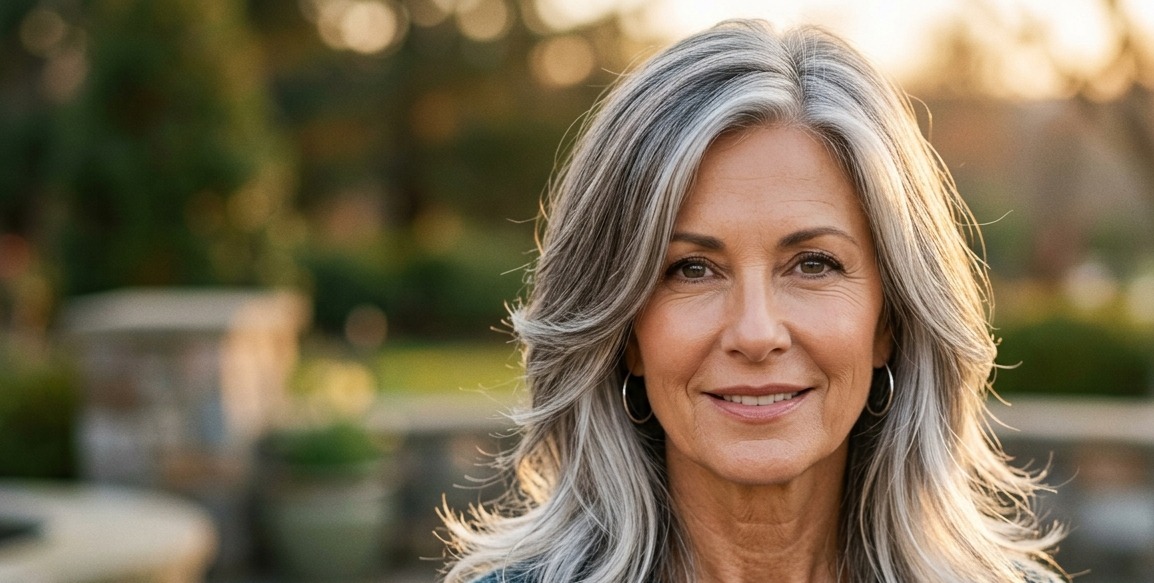
How to Style for Shine and Movement at Home
Since the 2025 alignment study found smoothness mattered more than shine products alone, the highest-leverage home step is a smoothing blowout — round or paddle brush through the crown and mid-lengths — finished with a lightweight shine serum on the ends only. Heavy product at the roots flattens the volume the layering is there to create in the first place.
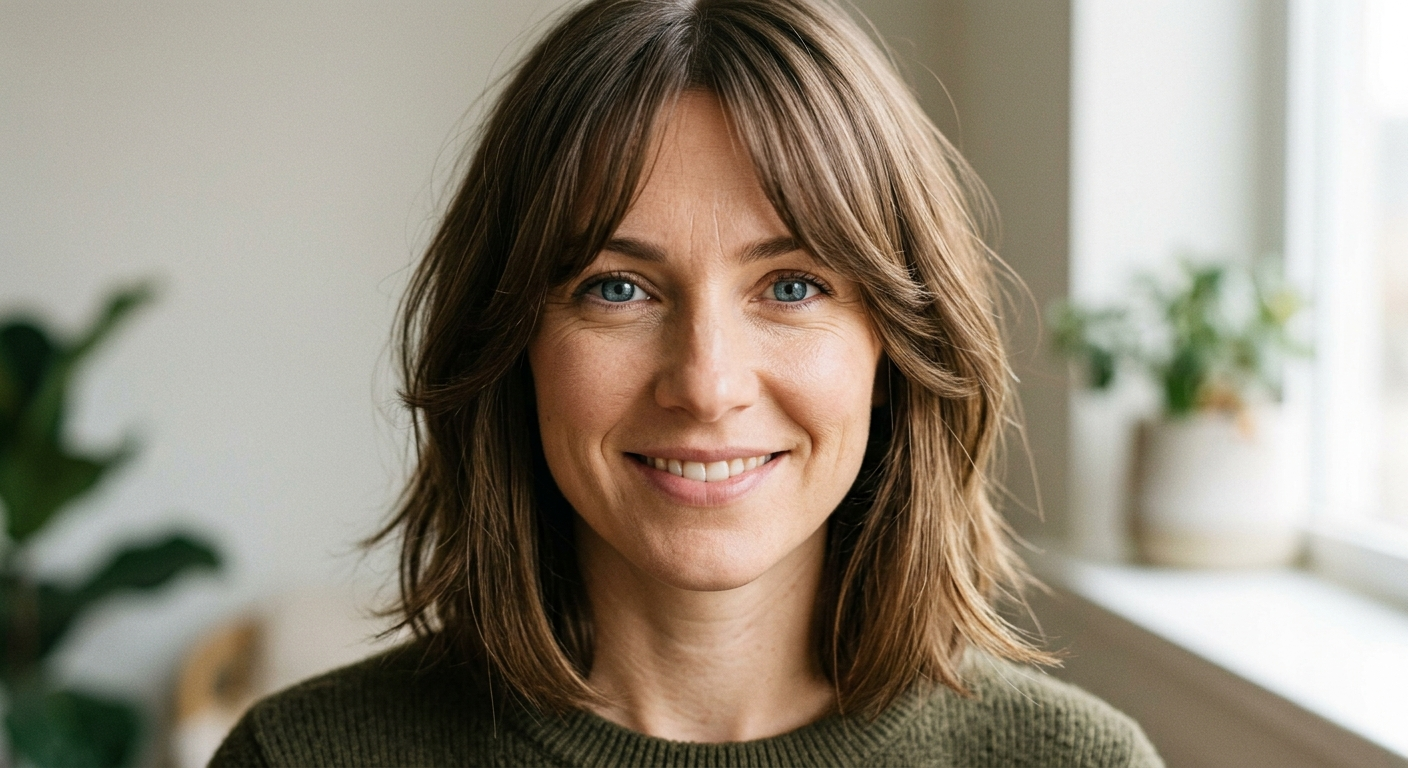
For the cutting technique itself, TheSalonGuy's "Perfect Face Framing Layers In Six Sections" and Sam Villa's "How to Cut Face Framing Layers" are both good references to bring up with your own stylist.
How to Ask Your Stylist for This Look
Be specific: ask for "face-framing layers," not just "layers," since the second can mean anything from subtle internal texture to a full heavy-layer treatment. Bring a reference photo, and mention if you're blending gray so your colorist and cutting stylist coordinate rather than working from two different plans.
The fastest way to build that reference photo is to make one of yourself. FaceStyle.fun's how-to guide walks through prepping a photo and previewing the Layered or Side-Swept Bangs preset before your appointment.
Does a haircut really make you look years younger, or is that just marketing language?
It's real, but the mechanism isn't magic — it's light. A 2025 study in the International Journal of Cosmetic Science had roughly 1,500-2,000 female raters judge photos with systematically altered hair, and found that shine and straight alignment measurably raised perceived youth, health, and attractiveness ratings, with alignment mattering more than shine alone (Will et al., 2025). No study has measured a specific 'years younger' number, so treat any claim that pins an exact figure to a cut or product with skepticism.
What is the single change most stylists recommend for a more youthful look?
Face-framing layers, often paired with curtain bangs. Celebrity hairstylist Michelle Cleveland describes the combination as something that "completely softens and frames the entire face for a softer, more youthful look" (Glam, 2024). It works on most face shapes because the layers are cut around the individual face rather than as a uniform blunt line.
Does hair actually get thinner with age, or does it just feel that way?
It genuinely thins for most people, though the timeline and severity vary widely. Hair density peaks around age 27 and starts declining from the mid-30s onward (Ahluwalia & Fabi, Journal of Cosmetic Dermatology, 2019). Female pattern hair loss compounds this for a meaningful share of women — a 2021 JAAD study found prevalence rising from 8% at ages 20-29 to 68% at ages 60-75.
Should I cover my gray hair or blend it to look younger?
Either can work — the styling questions matter more than the yes/no decision. If you're blending rather than fully covering, ask a colorist for a soft balayage that follows your natural gray pattern instead of a solid single-process color, since solid color grows out looking more like visible regrowth. For context, only about 6-23% of people actually reach 50% gray coverage by age 50, despite the popular '50-50-50 rule' claiming otherwise (Panhard, Lozano & Loussouarn, British Journal of Dermatology, 2012).
How often do face-framing layers need a trim to keep the shape?
Every 8-10 weeks for the overall shape, with a fringe trim every 3-4 weeks if your layers include curtain bangs. The face-framing pieces are usually the shortest layers in the cut, so they lose their line faster than the length underneath.
The Bottom Line
No cut takes a measurable number of years off your face — that framing sells product, not results. What the research does support is narrower and more useful: shine, alignment, and face-framing movement measurably shift how youthful hair reads, and specific cuts (face-framing layers, curtain bangs, a bixie, a layered lob) deliver those traits more reliably than a generic trim. Bring the specifics to your next appointment instead of the vague ask.