How to Know Your Face Shape in 30 Seconds (Free Tool)
"What's my face shape?" is one of the most searched hairstyling questions there is, and also one of the hardest to answer alone. Staring at your own reflection and guessing between round and oval, or heart and diamond, is genuinely difficult, your brain is bad at judging your own proportions objectively. The two-minute ruler method works, but it's fiddly, and it's easy to measure wrong.
FaceStyle.fun built a faster path: upload a selfie to the free AI face shape detector, and get your shape back in about 30 seconds, plus the hairstyles that actually suit it. This guide covers how the tool works, how it compares to measuring yourself, and what to do with the result once you have it.
Key Takeaways
- FaceStyle.fun's face shape detector is free, requires no signup or credits, and returns a result in about 30 seconds from a single selfie.
- A deep-learning model classified face shapes with 84.4-84.8% accuracy in a controlled benchmark study, well above simpler pattern-matching methods at 36.4-64.6% on the same task (Tio, arXiv:1911.07916, 2019).
- The classic DIY method, comparing forehead, cheekbone, and jaw width against face length, is the same underlying logic hairstylists and craniofacial researchers have used for decades (Farkas measurement system, Archives of Facial Plastic Surgery, 2010), but it is easy to measure inconsistently by hand.
- A front-facing photo with hair pulled back and even lighting gives the most reliable result, from either method.
The 2-Minute Ruler Method, and Where It Falls Short
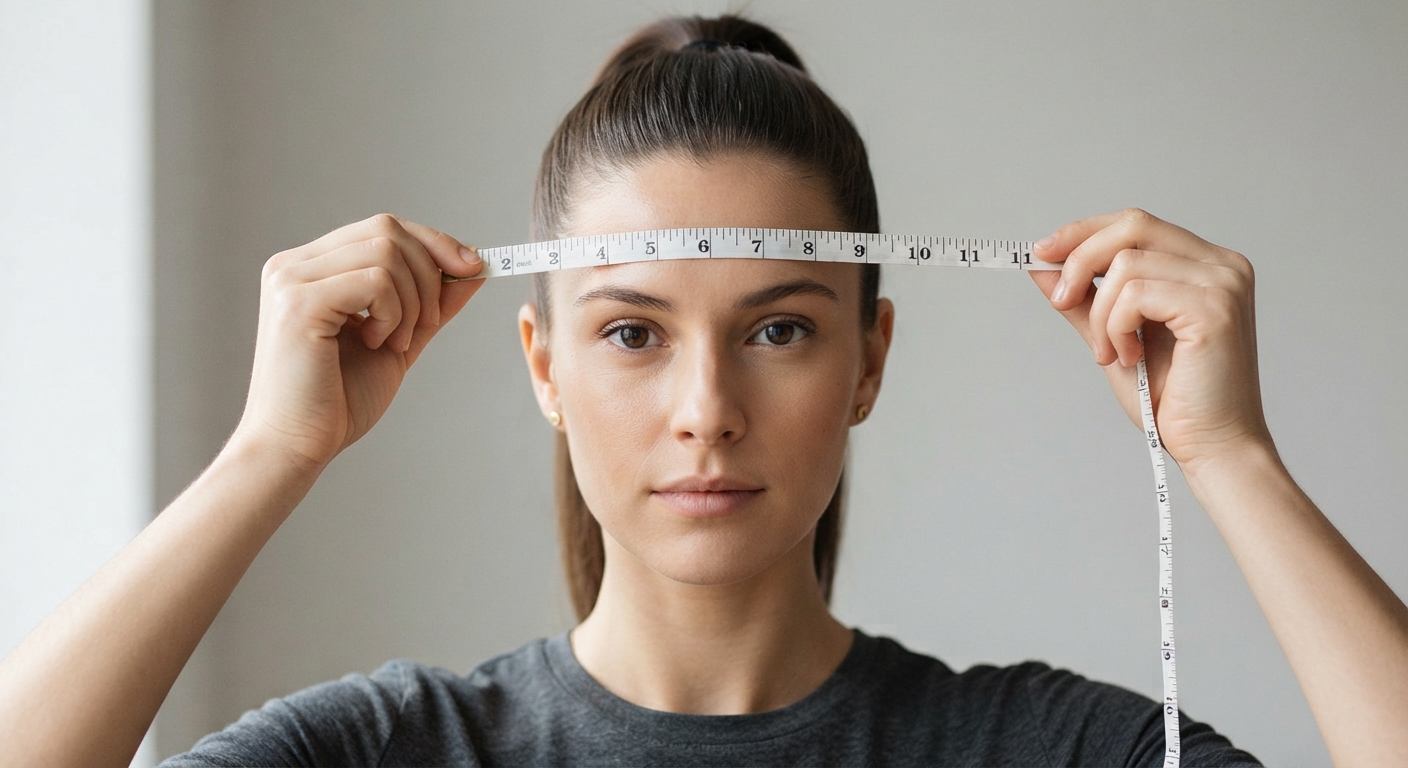
The traditional way to find your face shape is to pull your hair back, face a mirror in even light, and measure four things with a soft tape or ruler: forehead width at its widest point, cheekbone width, jaw width at its widest point, and overall face length from hairline to chin. This is the same core method FaceStyle.fun's full face shape guide walks through in detail, and it's a legitimate approach; it traces back to the Farkas system of craniofacial anthropometry, built from measurements of over 2,500 subjects and still referenced in facial plastic surgery literature today ("Leslie G. Farkas: Pioneer of Modern Craniofacial Anthropometry," Archives of Facial Plastic Surgery, 2010).
Where it falls short is consistency. Measuring your own face with a ruler held at arm's length, then comparing four numbers against each other and matching them to a shape description, leaves a lot of room for error: a slightly tilted ruler, an asymmetrical face (most faces are, at least a little), or simply not being sure where "widest point" actually is. It's a fine method with practice, but it's not the fast, reliable answer most people are actually looking for when they type "what's my face shape" into a search bar.
Why an AI Tool Reads Proportions More Consistently
This isn't a hunch, it's been tested directly. A 2019 computer vision study built a face shape classifier by retraining an Inception v3 deep learning model on 500 labeled celebrity photos, then compared it against five traditional pattern-matching methods (LDA, SVM, MLP, KNN) on the identical classification task. The deep learning model hit 84.4-84.8% overall accuracy; the traditional methods ranged from just 36.4% to 64.6% on the same faces (Tio, "Face shape classification using Inception v3," arXiv:1911.07916, 2019).
That gap is the whole reason a photo-based tool is worth using over eyeballing it yourself: a model trained specifically to read forehead, cheekbone, jaw, and length proportions doesn't get tired, doesn't second-guess a ruler measurement, and isn't judging its own reflection.
How FaceStyle.fun's Face Shape Detector Works
Upload one clear, front-facing photo, no account needed. The AI reads the same underlying proportions a stylist would (forehead, cheekbone, and jaw width against overall face length) and returns your shape, oval, round, square, heart, diamond, or oblong, along with a short explanation of why. From there it immediately shows a shortlist of hairstyles suited to that shape, pulled straight from FaceStyle.fun's style library, so you can preview one on your own face in the same session.
| Method | Time | Consistency |
|---|---|---|
| Eyeballing it in a mirror | Instant | Low — highly subjective |
| Ruler-and-tape measurement | ~2 minutes | Medium — accurate with practice, easy to mismeasure |
| AI face shape detector | ~30 seconds | High — trained specifically on this classification task |
The 6 Face Shapes at a Glance
Whether you use the tool or measure by hand, here's what each result actually means. For the full hairstyle-by-hairstyle breakdown, see the complete face shape hairstyle guide.
| Face shape | How to spot it |
|---|---|
| Oval | Balanced proportions; face length is about one and a half times the width; jaw slightly narrower than the forehead. |
| Round | Full cheeks and a softly curved jawline; width and length are close to equal. |
| Square | Strong, angular jawline; forehead, cheekbones, and jaw are all similar widths. |
| Heart | Wider forehead and cheekbones tapering to a narrow, sometimes pointed chin. |
| Diamond | Narrow forehead and jawline with the widest point at the cheekbones. |
| Oblong | Noticeably longer than it is wide, with fairly straight, even sides. |

Getting the Most Reliable Result
The same rule applies whether you're using the AI tool or measuring by hand: the photo (or the mirror check) is only as good as the framing. Pull your hair back so your hairline and jaw are both visible, face the camera straight-on rather than at an angle, and use even lighting rather than a single harsh side light, which can throw shadows that distort where your jaw or cheekbones actually end.
For a second professional take, GQ's "How to Choose the Best Haircut for Your Face Shape" covers the same fundamentals with a men's-grooming focus.
Is the FaceStyle.fun face shape detector actually free?
Yes. It runs on the same AI used for the styling tool, and you can upload a photo and get a result with no signup, no credits, and no payment. Creating a free account afterward just lets you save the result and get more personalized recommendations later.
How accurate is an AI face shape detector compared to guessing it yourself?
In a controlled benchmark study, a deep-learning model classified face shapes with 84.4-84.8% accuracy on a labeled photo dataset, well above simpler pattern-matching methods, which topped out around 36.4-64.6% on the same task (Tio, arXiv:1911.07916, 2019). No method, human or AI, is perfect, since plenty of real faces sit between two categories, but a model trained specifically on this task reads proportions more consistently than eyeballing a mirror.
What kind of photo works best for the detector?
A clear, front-facing photo in even lighting, with your hair pulled back so your hairline, cheekbones, and jaw are all visible. Avoid extreme angles, heavy filters, or photos where your face is partially turned, since those all distort the proportions the AI is reading.
Does the tool store or share my photo?
FaceStyle.fun processes your photo to generate the result and follows the same privacy-first handling as the rest of the site: uploads are used for your session and not sold or shared with third parties.
Does this replace the full face-shape hairstyle guide?
No, they're built for two different moments. This tool exists to answer "what's my face shape" in seconds. Once you know your shape, FaceStyle.fun's [face shape hairstyle guide](/blog/face-shape-hairstyle-guide) has the full breakdown of which cuts, lengths, and partings actually suit each one.
What if the detector's result doesn't feel right?
Most real faces are a blend of two shapes rather than a textbook match for one, so a borderline call is normal, not a bug. Try a clearer, more front-facing photo with your hair pulled back, and if it still feels off, treat the two closest shapes as your real shortlist rather than forcing a single answer.
The Bottom Line
You don't need a ruler, a stylist appointment, or a debate with a friend to find out your face shape. Upload one clear photo, get an answer in about 30 seconds, and see the hairstyles that actually suit it before you decide on anything.